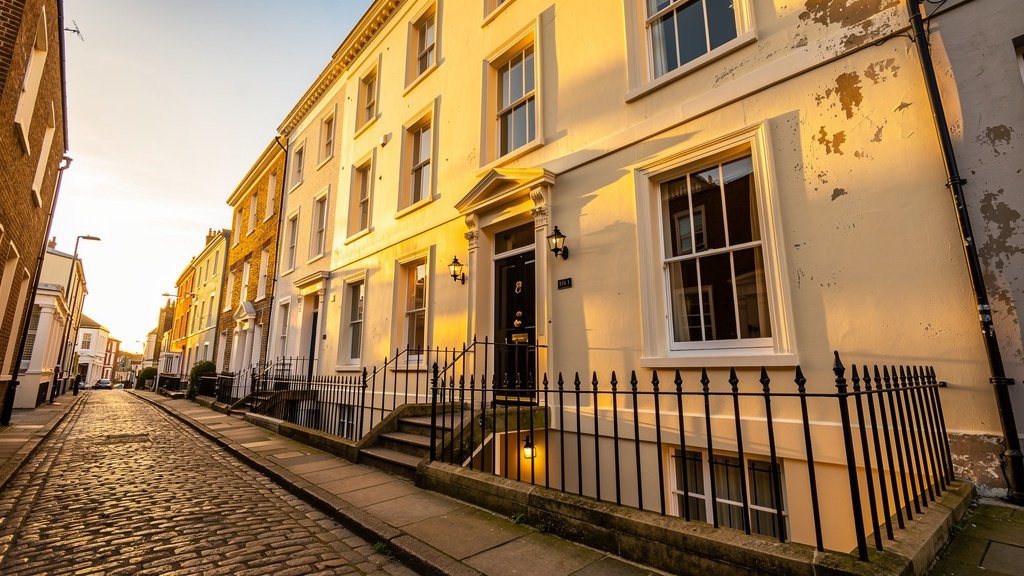
Old Portsmouth's Georgian streets — the Cathedral Quarter, Pembroke Road, Highbury Street, and the streets close to the historic Camber Dock — contain some of the most characterful and sought-after properties in Hampshire. Built between roughly 1714 and 1830, these houses were constructed before building regulations, using locally-sourced materials and the craftsmanship of an era that predates the Industrial Revolution. They are beautiful, robust, and full of surprises for the unprepared buyer.
What Makes Georgian Properties Different?
Georgian buildings were constructed using techniques and materials fundamentally different from anything built after 1850. Understanding these differences is essential for any surveyor — and for any buyer — before assessing condition or planning maintenance.
Solid-Wall Construction
Georgian properties are built with solid brick or stone walls, typically one-and-a-half to two bricks thick. There is no cavity. This means moisture management works entirely differently from modern construction: the walls are designed to absorb and release moisture as part of the building's natural breathing cycle. Introducing modern impermeable materials — cement render, modern masonry paint, or chemical damp-proof courses — interferes with this cycle and almost always causes more problems than it solves.
Lime Mortar Throughout
Georgian brickwork is pointed with lime mortar — a soft, flexible material that was designed to be the sacrificial element in the wall assembly. Lime mortar is softer than the brick and absorbs movement, thermal expansion, and moisture stress. When repointed with hard Portland cement (as many Georgian properties have been over the decades), the cement traps moisture and cracks the brick faces rather than the joints. Our surveys always check for inappropriate repointing, which is one of the most common sources of accelerated masonry deterioration in Old Portsmouth.
Timber Structure
Floors, roof structures, and internal partitions are almost entirely timber. Original softwood floor joists and roof timbers, if kept dry, can remain structurally sound after 250 years. If they have been wet — from roof leaks, plumbing failures, or rising damp — they deteriorate rapidly and can fail with little visible warning. Timber probe testing and moisture meter readings at joist ends and wallplate level are standard procedure in our Georgian surveys.
Original Sash Windows
Original six-over-six or eight-over-four sash windows are one of the defining features of Georgian properties — and one of the most contentious maintenance items. Where original, they are typically listed building elements and cannot be replaced without consent. Even where not listed, original sashes are worth retaining: correctly maintained, they outperform modern windows in terms of longevity. Our survey assesses every sash for rot, broken cords, failed glazing putty, and rattling — and provides realistic repair cost estimates.
Common Defects in Old Portsmouth Georgian Properties
1. Cement Repointing Damage
As described above, this is the single most common finding in our Georgian surveys. The visual tell-tale is mortar that is grey and hard rather than cream or buff-coloured, often with hairline cracking at the mortar-to-brick interface. Remediation requires careful raking out of cement joints and replacement with an appropriate lime mortar. Costs depend on the extent of affected areas but typically range from £3,000 to £12,000 for a full repoint.
2. Damp from Multiple Sources
In Georgian properties, damp almost never has a single cause. We typically find a combination of: penetrating damp through failed or inappropriate render; condensation from modern living patterns (poor ventilation in a tightly sealed old building); and in some cases genuine rising damp where the original ground-level drainage has been compromised. The key diagnostic question is always: what changed? An old building that was dry for 200 years and is now damp has usually been subjected to a modern intervention that upset its natural moisture balance.
3. Structural Movement
Georgian buildings move. They always have. Original lime-mortar construction was designed to accommodate movement through the flexibility of the joints. Diagonal cracking at window and door corners, slight floor undulation, and out-of-plumb walls are all normal in a 200-year-old building. The key question our survey addresses is whether observed movement is historic and stable (very common) or active and progressive (rare, but serious). We use tell-tale monitoring references and crack width assessment to make this determination.
4. Roof Structure and Coverings
Original Welsh slate roofs, where intact, are effectively maintenance-free. The problem is that many Old Portsmouth Georgian roofs have had slates replaced with modern concrete or fibre-cement tiles — which are heavier and can overstress the original timber structure. We check not only the covering condition but the structure underneath: wallplate condition, rafter sizing, and purlin support. Where original lead parapet gutters and flat-roof valleys are present, we assess these separately as they have a shorter maintenance cycle.
5. Services and Drainage
Georgian properties will typically have had at least two or three complete rewires and several plumbing updates over their lifetime. Even so, we frequently encounter partial rewires leaving older rubber-insulated cable in secondary circuits, lead or iron water supply pipes in sections, and original salt-glazed ceramic drainage. A CCTV drain survey is strongly recommended for any Georgian property purchase — root intrusion and fractures in 19th-century drainage are extremely common.
6. Listed Building Status and Planning Constraints
Many of Old Portsmouth's Georgian properties are either individually listed or within a Conservation Area. This affects what changes require consent, what materials must be used for repairs, and what permitted development rights apply. Our surveys note listed status and conservation area designation, and flag any unapproved alterations that might require retrospective consent or reinstatement. Always check with Portsmouth City Council's planning portal before committing to a purchase that involves intended alterations.
Why Georgian Properties Always Need a Level 3 Building Survey
A Level 2 HomeBuyer Survey is not appropriate for Georgian properties. The Level 2 format does not allow for the depth of investigation, the specialist knowledge of historic construction, or the cost estimating that these properties require. A Level 3 Building Survey is the correct — and the only responsible — product for any property built before 1850. It allows us to:
- Carry out full probe testing of all accessible timber elements
- Take moisture readings at multiple points on all external walls
- Assess roof structure from the loft space
- Comment on the appropriateness of previous repairs and materials
- Provide detailed cost estimates for all identified defects
- Recommend appropriate specialist investigations (structural engineer, CCTV drain survey, etc.)
Georgian Properties as Investments: The Long View
Despite their complexity, Georgian properties in Old Portsmouth are excellent long-term investments for buyers who understand what they're buying. They appreciate strongly because supply is fixed, demand from buyers who value character and history is consistent, and their robust solid-wall construction means they outlast modern buildings by centuries when correctly maintained. The key is buying with full knowledge of current condition and realistic maintenance budgets — exactly what a thorough Level 3 survey provides.
"Georgian properties are the most rewarding to survey because they have a story to tell. Every crack, every repair, every layer of wallpaper is a record of how the building has been used and maintained. Our job is to read that story accurately and give buyers the information they need to write the next chapter wisely." — Richard Hawkes, MRICS MCIOB, Principal Surveyor
Book a Georgian Property Survey Today
Buying in Old Portsmouth, Southsea, or anywhere in Hampshire? Our RICS surveyors have extensive experience with Georgian and pre-Victorian properties. Get your free, fixed-price quote today.