Southsea seafront is one of the most desirable places to live in Hampshire. Wide promenades, sea views, and easy access to the South Downs via the Solent coast make waterfront and near-seafront properties perennially popular. But coastal living comes at a price — and it's not just the premium on purchase price. Properties within 500–800 metres of the sea face an entirely different set of defects than those further inland, and buyers who don't commission a specialist survey are taking a substantial risk.
Why Coastal Properties Are Different
The Solent creates a uniquely harsh microclimate for buildings. Salt-laden air accelerates corrosion of metal fixings, flashings, gutters, and window hardware. The combination of driving rain from the south-west, high humidity, and frequent freeze-thaw cycles attacks masonry, pointing, and render more aggressively than in sheltered inland locations. Add to that the tidal influence on water tables, and you have a set of conditions that require a surveyor with specific coastal experience.
Our team has surveyed hundreds of properties along Southsea seafront, Eastney, Gunwharf Quays, and the Old Portsmouth shoreline. Here's what we consistently find:
The Six Most Common Coastal Defects in Southsea Properties
1. Salt Crystallisation and Spalling Masonry
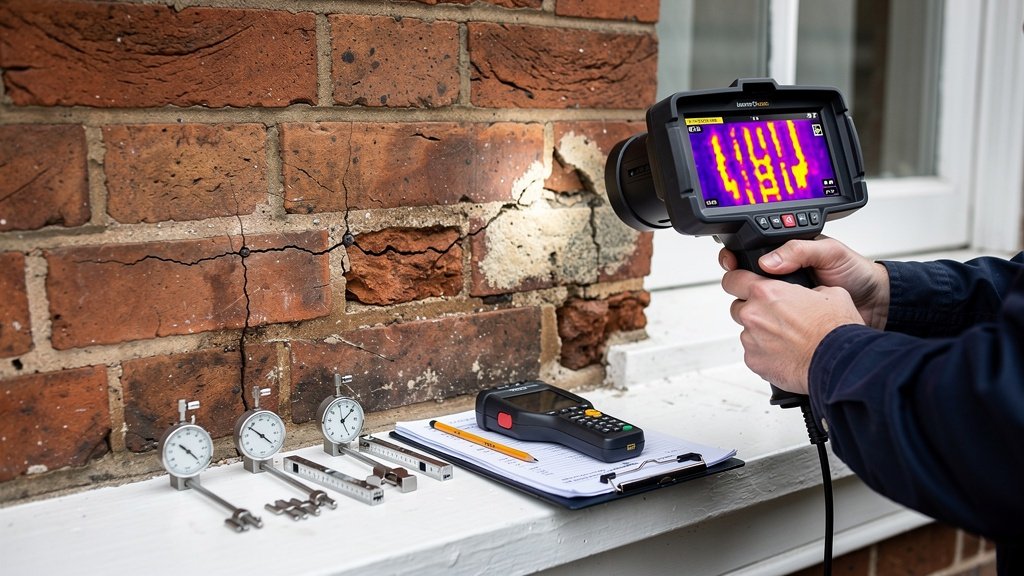
Salt from sea spray infiltrates porous Victorian brickwork and sandstone. As the salt crystallises during drying, it expands inside the masonry, causing spalling (where the brick face flakes away) and accelerated erosion of mortar joints. On south- and west-facing elevations, we regularly identify masonry that needs complete repointing and in some cases partial rebuilding. Typical costs: £2,000–£8,000 depending on elevation size and accessibility.
2. Corroded Metal Elements
Cast-iron gutters, lead flashings, steel lintels, and window hardware corrode at roughly twice the rate of identical components in inland properties. We always pay particular attention to concealed steel lintels above window and door openings — rusting lintels expand and crack the surrounding masonry, creating water ingress pathways. In flat-roofed extensions, corroded metal decking is a persistent problem. Budget for regular inspection and replacement cycles roughly 20–30% shorter than standard.
3. Flat-Roof Failures
Many Southsea Victorian terraces have rear additions and bay extensions with flat or near-flat roofs. These are vulnerable to water ponding and UV degradation, and coastal UV intensity is marginally higher at sea level. We recommend thermal imaging for any flat-roof element on a coastal property — moisture trapped in the insulation layer is invisible to the naked eye but causes progressive structural damage.
4. Penetrating Damp Through External Render
Failed or poorly applied render is one of the most frequent findings in our Southsea surveys. When render cracks, rainwater enters the wall cavity but cannot evaporate because the render traps it. Salt from the masonry is then drawn to the internal wall surface as the wall tries to breathe, producing the characteristic white efflorescence staining and, in more severe cases, active internal dampness. The solution is not always a damp-proof course — it is almost always render repair or replacement.
5. Flood Risk and Water Table Considerations
Parts of Southsea, particularly low-lying areas behind the seafront, sit within Flood Zone 2. The Environment Agency flood map should be checked before any offer is made. Beyond river or coastal flooding, high water tables near the seafront mean basements and lower ground-floor spaces are at elevated risk of groundwater ingress. We use a combination of moisture meters and visual inspection to identify historic flood damage patterns.
6. Timber Window and Door Frame Deterioration
Original sash windows in Victorian Southsea terraces are typically softwood. Close to the seafront, the combination of salt spray, moisture, and UV causes accelerated paint breakdown and timber rot — particularly at the base rails and sill ends where water pools. Many properties we survey have had windows painted over repeatedly without stripping, concealing significant rot beneath. A thorough probe test with a bradawl is standard procedure in our coastal surveys.
What a Coastal Survey Should Cover
A standard Level 2 HomeBuyer Survey covers the visible condition of all accessible elements. For coastal properties, we recommend a Level 3 Building Survey, which includes:
- Detailed inspection of all external elevations, with notes on pointing condition, render adhesion, and masonry spalling
- Probe testing of all external timber elements
- Moisture meter readings at multiple points on all external-facing walls
- Thermal imaging for flat-roof elements (where accessible)
- Assessment of all metal elements including gutters, flashings, lintels, and fixings
- Commentary on flood risk and insurance implications
- Cost estimates for all identified defects
Specific Areas We Cover Along the Southsea Coast
Our surveyors are familiar with every street in the Southsea coastal zone, including:
- Southsea Esplanade and South Parade — highest exposure properties; almost always require Level 3 surveys
- Eastney and Milton seafront — mix of Victorian terraces and 1930s semis; varying exposure levels
- Gunwharf Quays apartments — modern construction but harbour-facing; check service charges and external cladding
- Old Portsmouth and Camber Dock — historic properties with complex maintenance histories
- Clarence Pier and Western Parade — strong south-westerly exposure; check render and roof condition carefully
Coastal Properties and the Leasehold Question
Many desirable Southsea seafront properties are converted into flats and sold on long leases. In addition to all the physical defects above, leasehold buyers should scrutinise the service charge history — coastal buildings cost significantly more to maintain, and a poorly managed freeholder may have deferred expensive external works. Ask your solicitor to obtain the last three years' service charge accounts and enquire about any major works in the pipeline.
Insurance: Get a Quote Before You Commit
Buildings insurance can be difficult to obtain at a reasonable premium for properties in Flood Zone 2 or within 100–200 metres of the seafront. Some specialist insurers cover these properties, but premiums can be 50–100% higher than equivalent inland properties. In extreme cases — particularly for properties that have previously flooded — standard insurers may decline to quote entirely. Always obtain an insurance quote as part of your pre-exchange due diligence.
Our Recommendation: Coastal Specialist Surveyors
Not all surveyors have extensive coastal experience. When commissioning a survey for a Southsea or harbour-front property, ask specifically whether the surveyor has surveyed properties in that postcode before and whether they carry thermal imaging equipment. At Portsmouth Surveyors UK, coastal properties represent a significant proportion of our annual workload — we know what to look for, and we know how to cost it accurately.
"Coastal properties reward buyers who do their homework. A thorough Level 3 survey on a Southsea seafront terrace costs around £600 — but routinely identifies defects requiring £15,000–£30,000 of remediation. That's not a reason not to buy; it's a reason to negotiate properly." — James Whitmore, Senior Chartered Surveyor, Portsmouth Surveyors UK
Book a Coastal Property Survey Today
Thinking of buying near the Southsea seafront, Old Portsmouth, or the Gosport waterfront? Our RICS surveyors know these properties inside out. Get a free, fixed-price quote today.