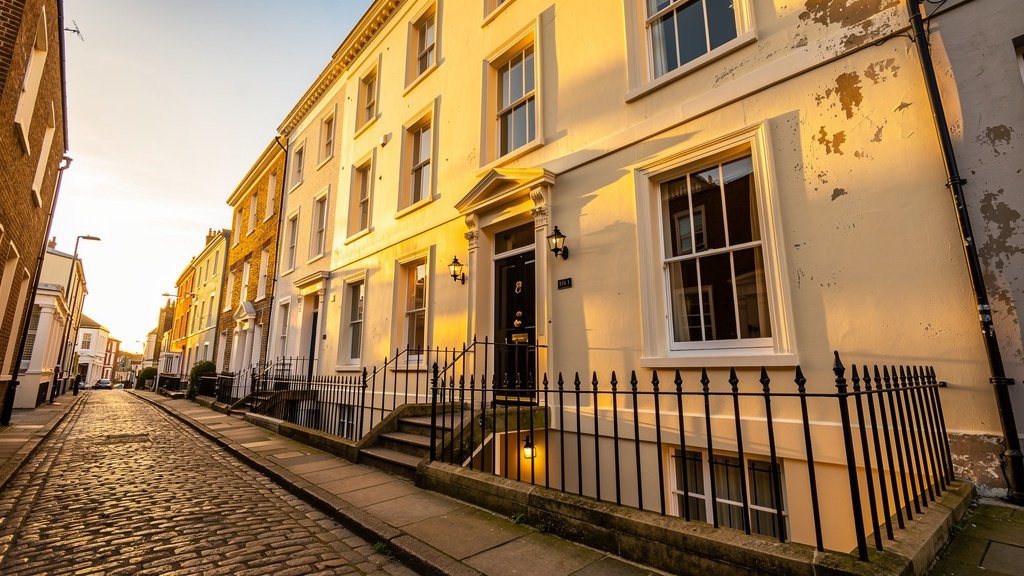
Portsmouth's Georgian properties — the elegant townhouses of Old Portsmouth, the grand terraces of Southsea's conservation area, the painted stucco facades overlooking the harbour — are among the most sought-after homes in the city. They also carry a level of complexity and potential cost that makes a rigorous, expert survey non-negotiable. Portsmouth Surveyors UK has surveyed more Georgian properties in this city than perhaps any other firm, and this guide distils what we've learnt.
I want to be direct with you: Georgian properties are not straightforward to survey. They were built in a completely different construction era, with materials and techniques that behave very differently from modern construction. They've typically been altered, repaired and "improved" multiple times over two centuries — sometimes sympathetically, often not. What's hidden behind plaster and panelling on a Georgian townhouse in Old Portsmouth could be anywhere on the spectrum from perfect to potentially catastrophic. This guide will help you understand what a thorough survey needs to look at, and what defects are most commonly found.
Portsmouth's Georgian Housing Stock
Portsmouth's Georgian properties were built between approximately 1714 and 1830, with the most significant concentrations in:
- Old Portsmouth (Spice Island) — some of the oldest surviving residential streets in the city, with properties dating to the mid-Georgian period and earlier; heavily bomb-damaged areas rebuilt post-war sit alongside genuine survivors
- Pembroke Road and King's Terrace, Southsea — elegant late-Georgian and Regency terraces built as Portsmouth expanded south in the early 19th century
- King's Road area — substantial three and four-storey townhouses, some now converted to flats
- Hambrook Street and surrounding streets — smaller-scale Georgian artisan properties, less grand but equally characterful
Portsmouth was heavily bombed during the Second World War, and many of the Georgian streets that exist elsewhere in the city were lost entirely. The surviving Georgian stock is therefore historically significant — many properties are Listed Buildings or within Conservation Areas — which adds a layer of planning complexity to any repair or alteration programme.
How Georgian Properties Were Built
Understanding how Georgian buildings were constructed is fundamental to understanding the defects they develop. Portsmouth Surveyors UK surveys these buildings through the lens of their original construction logic:
Solid Masonry Walls
Georgian properties use solid brick or stone walls — there is no cavity. External walls were typically one brick (225mm) to one-and-a-half bricks (340mm) thick for smaller properties, and up to two bricks (450mm) for larger townhouses. The mortar was lime-based — softer and more flexible than modern cement mortars, and critically, designed to allow moisture vapour to pass through the wall (the building "breathes").
This breathing characteristic is central to everything. When modern cement repointing or render is applied to Georgian brickwork — as it very commonly is — it seals the wall, trapping moisture internally and accelerating decay. This is one of the most frequent and most costly errors we find in Portsmouth's Georgian housing stock.
Timber Frame Floors and Roofs
All Georgian properties use timber floor joists bearing into masonry walls — a construction method that creates very specific vulnerabilities. The joist ends embedded in external walls are susceptible to end-grain moisture penetration, leading to dry rot and wet rot if water finds its way in. Roof structures are similarly all-timber.
Lime Plaster Finishes
Original Georgian internal plaster is lime-based — typically three coats applied to timber lath. Lime plaster is more flexible than modern gypsum plaster, and it's been in place for 200 years. Where original plaster survives in good condition, it should be preserved if at all possible — lime plaster is repairable, breathable, and contributes to the moisture management of the building. Modern gypsum plaster applied over damaged areas can create incompatibility problems.
Basements
Many of Portsmouth's larger Georgian properties have basements — semi-subterranean rooms that originally served as service areas. These present particular challenges: they're inherently prone to dampness, may have been converted to habitable use over the years (often inadequately waterproofed), and can suffer from structural movement where external ground levels have altered.
Common Defects in Portsmouth's Georgian Properties
Based on Portsmouth Surveyors UK's extensive survey experience, here are the defects we most frequently identify:
Inappropriate Cement Repointing and Render
This is the single most common damaging intervention on Portsmouth's Georgian properties. Hard cement mortar is stronger than the original lime mortar and stronger than the bricks themselves. As the building moves (as all buildings do), the cement doesn't flex — instead, the stress is transferred to the bricks, causing spalling (face of the brick breaking away) and cracking. On rendered walls, cement render traps moisture inside the wall, leading to frost damage, structural deterioration and internal damp.
The remedy is to carefully remove cement repointing and replace with appropriate lime mortar — a skilled, time-consuming and relatively expensive process. A complete re-render with appropriate breathable lime render can cost £15,000–£40,000 on a large townhouse.
Timber Decay
Dry rot (Serpula lacrymans) and wet rot are endemic in Portsmouth's Georgian properties. The prime locations are: window and door frames at wall junctions; floor joist ends built into external walls; basement timbers; roof plate and rafter ends at eaves level; and hidden timbers behind later alterations.
Dry rot is particularly serious because it can spread through masonry, travelling significant distances from the original source of moisture. A single outbreak, if not caught early and treated comprehensively, can affect entire floor structures.
Settlement and Structural Movement
Two centuries of settlement has generally been accommodated in Georgian buildings that are still standing — but the character of that settlement matters. Portland or London Clay soils (found in parts of Portsmouth) have shrink-swell behaviour that causes seasonal movement. Early 19th-century foundations were often shallow by modern standards. Where tree root activity, drain leakage or groundwater changes have affected foundation soils more recently, renewed movement can be superimposed on historic settled cracks.
Roof Structure Defects
Georgian roof structures are typically close-coupled rafters with no ridge board, relying on wall plates and ceiling joists to resist the outward thrust. Over time, wall plates can fail, ceiling joists can weaken, and the roof can spread — pushing the tops of external walls outward. This appears as cracking at eaves level and, in more serious cases, as a visible bow or bulge in the wall face.
Roof covering defects are almost universal on Georgian properties — original Welsh slate has a limited life and is now typically over 150 years old. Valley lead, parapet gutters and chimney flashings are all common failure points.
Services
Electrical, heating and plumbing installations in Georgian properties have often been updated multiple times — and the legacy of each update is typically hidden within wall and floor chases. It's not uncommon to find three generations of wiring in the same property. Old rubber-insulated wiring (pre-1960s) is a fire risk and requires full rewiring. Lead pipework from the original installation may still be in use in some older Portsmouth properties.
Listed Building and Conservation Area Constraints
Many of Portsmouth's Georgian properties are Listed (Grade II or above) or sit within Conservation Areas. This has significant implications for what work can and cannot be done without consent — and for what remediation options are available. Standard modern repair methods may not be permissible. Portsmouth Surveyors UK understands these constraints and ensures our repair recommendations are compatible with planning requirements.
How Portsmouth Surveyors UK Approaches Georgian Surveys
A Level 3 Building Survey is always the right choice for a Georgian property — there's no debate about this. But even within Level 3 surveys, the quality of the inspection depends entirely on the surveyor's understanding of Georgian construction and period property defects. Here's what our approach covers:
- Masonry assessment: Identifying mortar type, evidence of cement repointing, spalling brickwork, render condition
- Moisture assessment: Damp meter readings at multiple points throughout, distinguishing damp types, assessing causes
- Structural assessment: Crack mapping, assessment of movement history, identification of any active movement indicators
- Roof structure: Full loft inspection including roof plate, joist ends, purlin and rafter condition, roof covering
- Timber decay: Targeted inspection of all high-risk locations; probe testing where necessary
- Basement: Thorough assessment of waterproofing, structural condition, services
- Services assessment: Visual inspection; age and condition of electrical, heating and plumbing installations
- Heritage constraints: Identification of Listed Building or Conservation Area status and implications for repair
Practical Buying Advice for Portsmouth Georgian Properties
If you're considering buying a Georgian property in Portsmouth, here's what I'd tell any client:
Budget for ongoing maintenance. Georgian properties require more maintenance than modern homes — this isn't a reason not to buy one, but it's a reality to plan for. Budget 1–2% of the property value annually for maintenance.
Find a surveyor who knows period properties. The difference between a surveyor who genuinely understands Georgian construction and one who doesn't is enormous. Ask about their specific experience with listed buildings and period properties before booking.
Get specialist quotes for any significant works before exchange. If the survey identifies major items — roof replacement, re-render, dry rot treatment, rewiring — get contractor quotes before you exchange contracts. This is essential for negotiating the price and for ensuring you've budgeted accurately.
Check Listed Building status early. A quick check on the Historic England Listed Buildings register (free online) will tell you if the property is listed and at what grade. Grade I and Grade II* listed properties carry the most restrictions and require specialist conservation consultants for any significant works.
Talk to the neighbours. In Georgian terraces, neighbouring properties are structurally linked. What's happening next door matters. Have there been drainage problems? Recent building works? Structural repairs? Neighbours are often the best source of informal intelligence about the terrace as a whole.
Frequently Asked Questions About Georgian Property Surveys in Portsmouth
Does a Georgian property always need a Level 3 survey?
Yes, without exception. Georgian properties are complex, potentially altered buildings that are over 200 years old. A Level 2 HomeBuyer Survey is designed for conventional properties in reasonable condition — it does not have the scope to properly assess the construction complexity, potential defects and heritage considerations of a Georgian property. Portsmouth Surveyors UK will not carry out a Level 2 survey on a Georgian property, as we don't believe it provides adequate protection to the buyer.
Can I get a mortgage on a Georgian listed building?
Yes — many lenders mortgage Listed Buildings routinely. However, some lenders apply restrictions, particularly for Grade I and Grade II* properties, and may require a specialist surveyor's report confirming the property's structural condition. Interest rates may be slightly higher. Buildings insurance for listed properties typically costs more than standard cover, and specialist listed building insurers are recommended.
How much does it typically cost to renovate a Georgian townhouse in Portsmouth?
Renovation costs vary enormously depending on condition and specification, but as a rough guide: a Georgian townhouse in poor condition requiring full renovation (new roof, replastering, rewiring, plumbing, central heating, kitchen, bathrooms, redecoration) in Portsmouth might cost £80,000–£200,000+ depending on size and specification. Getting a detailed Level 3 survey, followed by quotes from specialist contractors, before exchange of contracts is essential for financial planning.
Is lime mortar repointing really necessary?
For Georgian brickwork, yes — it's not a nice-to-have, it's genuinely necessary for the long-term health of the building. Using modern cement mortar on Georgian brickwork is like putting a plaster cast on a bruise — it prevents the building from functioning as it was designed to, and causes long-term damage. It's also generally required for Listed Buildings. The labour cost is higher than cement repointing, but the alternative is accelerating brick spalling and internal damp problems that cost far more to remediate.
What's the difference between a Victorian and Georgian property, and does it matter for surveys?
Georgian properties predate 1830; Victorian properties were built 1837–1901. For surveying purposes, both are solid-wall, lime-mortar constructions with timber floor and roof structures. The key differences are: Georgian properties are older (more time for defects to develop and interventions to accumulate); they're more likely to be listed; they often have more elaborate architectural features (cornicing, shutters, panelling) that require specialist knowledge to assess and repair; and their foundations are generally shallower than late-Victorian properties. Both warrant a Level 3 survey — but Georgian properties warrant particular caution.
The Right Survey Makes Georgian Buying Manageable
Buying a Georgian property in Portsmouth is one of the most rewarding property decisions you can make — these buildings have character, history, and a quality of construction that modern homes simply can't match. But it requires eyes wide open, proper professional advice, and realistic budgeting. Portsmouth Surveyors UK has the specific expertise in period property surveying to give you exactly that.