If you're buying a property in Portsmouth, one of the first questions you'll face is: do I need a Level 2 or a Level 3 survey? The answer matters — both for your peace of mind and your bank balance.
I've been carrying out surveys across Portsmouth and Hampshire for over 15 years, and this is genuinely the question I get asked most often. So let me give you a straight answer — no jargon, no waffle.
First, What Are Levels 2 and 3?
Back in 2021, RICS (the Royal Institution of Chartered Surveyors) updated the way residential surveys are structured and named. The old Condition Report, HomeBuyer Report and Building Survey became Levels 1, 2 and 3 respectively under the new RICS Home Survey Standard.
The names changed but the substance largely didn't. Here's what each level actually covers:
- Level 1 (Condition Report): Basic traffic-light overview. Very little detail. Rarely recommended for any Portsmouth property.
- Level 2 (HomeBuyer Survey): A solid mid-range survey covering the overall condition of the property, defects, damp, and key risks. Usually the right choice for standard homes in reasonable condition.
- Level 3 (Building Survey): The most thorough option. Full structural assessment, construction method analysis, defect investigation, and cost estimates. Essential for older, extended or complex properties.
What Does a Level 2 HomeBuyer Survey Actually Cover?
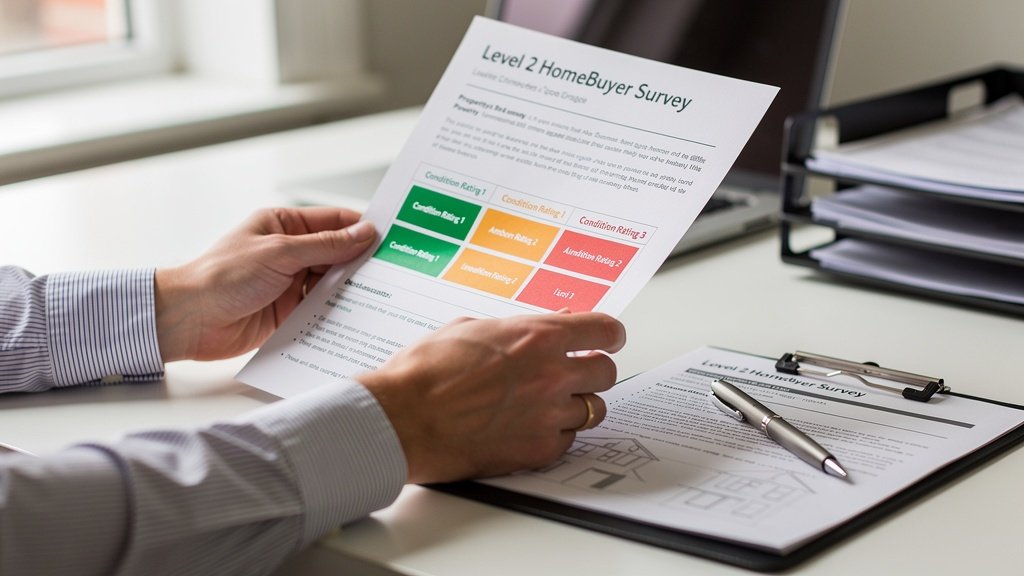
When I carry out a Level 2 survey, I'm inspecting every accessible part of the property — from the roof and chimney stacks to the basement (if accessible). I'll assess the overall condition of the property using RICS's three-point traffic light system:
- Condition 1 (Green): No repair needed. Normal maintenance only.
- Condition 2 (Amber): Defects that need attention but aren't urgent or serious.
- Condition 3 (Red): Serious defects or conditions requiring urgent repair — or further investigation before you exchange.
I'll check for damp and moisture using a calibrated damp meter, look for evidence of movement in walls and ceilings, assess the roof covering from ground level, inspect accessible drains, and flag any legal issues to refer to your solicitor.
What I won't do in a Level 2 survey is lift floorboards, open up wall cavities, or carry out detailed structural analysis. If I find evidence of something more serious — say, significant cracking that suggests possible subsidence — I'll note it and recommend further investigation. But the Level 2 survey won't tell you why it's cracking or what it would cost to fix.
What Does a Level 3 Building Survey Add?
A Level 3 building survey is essentially a Level 2 survey plus a deep dive into the structure and construction of the building. When I do a Level 3, I'll typically spend 3–4 hours on site rather than 2–2.5 hours. I'll access the loft if at all possible, inspect under floors where accessible, and examine the building's construction method in detail.
Here's what you get that you don't with a Level 2:
- Full structural analysis — including movement assessment, crack investigation and foundation commentary
- Subsidence investigation — looking for evidence of historical or ongoing ground movement
- Construction method breakdown — what the walls are built from, what the roof structure looks like, how the floors are constructed
- Remedial cost estimates — so you can walk into any price negotiation with real numbers
- Detailed assessment of any alterations or extensions
- Comments on non-standard construction issues (solid walls, lime mortar, original timber frames)
"A Level 2 survey is like a thorough medical check-up. A Level 3 is like getting an MRI. Both are valuable — but the MRI tells you things the check-up can't see."
— James Whitmore, Senior Chartered Surveyor
Which Is Right for a Portsmouth Property?
This is where local knowledge really matters. Portsmouth's unique property stock means the right answer varies significantly depending on exactly what you're buying.
Here's my honest guidance:
Choose a Level 2 HomeBuyer Survey if:
- The property was built after 1945 and is of standard brick construction
- It appears in reasonable condition from the outside
- It hasn't been significantly extended or converted
- It's a conventional house, flat or bungalow
- You want reassurance about the main elements without full structural analysis
Choose a Level 3 Building Survey if:
- The property is a Victorian terrace in Southsea or Fratton (pre-1914)
- It's a Georgian terrace in Old Portsmouth (pre-1850 — potentially much older)
- The property has been extended, converted or significantly altered
- There's any visible evidence of cracking, damp or movement
- The property is within 500 metres of Southsea seafront (coastal exposure risk)
- It's a listed building or in a conservation area
- You're paying a significant sum and want comprehensive reassurance
My Rule of Thumb for Portsmouth
If the property was built before 1940 — and that includes the vast majority of Southsea, Old Portsmouth, Fratton and much of North End — I'd almost always recommend a Level 3 Building Survey. The potential cost of missing a significant defect is far greater than the extra £150–200 a Level 3 costs over a Level 2.
What's the Cost Difference?
For a typical two-bedroom Victorian terrace in Southsea with a purchase price of around £250,000:
- Level 2 HomeBuyer Survey: Around £400–£450
- Level 3 Building Survey: Around £575–£650
The difference is roughly £150–£200. Given that a Level 3 survey might uncover structural issues worth £20,000+ in repair costs — as it does regularly in Portsmouth's older terraces — that extra £200 is almost always money well spent.
Both survey types can include an optional RICS market valuation for an additional fee (typically £100–£150 extra). This gives you an independent professional view of what the property is worth — useful both for your own decision-making and for any price negotiation.
A Real Example from My Portsmouth Survey Work
Last year, I surveyed a Victorian terrace in Fratton that a client had been told was "in good condition" by the estate agent. They were considering a Level 2 survey. I advised a Level 3.
What we found: significant subsidence in the rear extension, caused by tree root activity in a nearby silver birch that the vendor hadn't disclosed. The front bay window was also showing signs of severe outward lean — not visible from the street but very apparent once you looked carefully. Total estimated repair cost: £31,000.
My client renegotiated £22,000 off the purchase price. The Level 3 survey cost £620.
That's not an unusual outcome. It's why I'm passionate about recommending the right type of survey for every property.
Frequently Asked Questions
Yes — if you book a Level 2 and subsequently decide you'd like a Level 3, just let us know before the inspection takes place and we'll adjust the survey scope and fee. We can't upgrade after the inspection has been carried out.
For a purpose-built flat in a modern block, a Level 2 is usually sufficient. For a converted Victorian house divided into flats — very common in Southsea — a Level 3 may be appropriate, particularly if the property is older or the conversion work looks untidy. Ask us and we'll give you honest advice.
A mortgage valuation is carried out by your lender to confirm the property is worth enough to secure the loan. It is not a survey and doesn't check the condition of the property in any detail. You should always commission an independent survey as well.
The Bottom Line
For most Portsmouth properties — especially anything built before 1940 — a Level 3 Building Survey is the right choice. Yes, it costs a bit more. But in a city of Victorian and Georgian terraces where damp, structural movement and undisclosed alterations are genuinely common findings, the extra coverage is worth every penny.
If you're buying a post-war property in reasonable condition and you're confident there are no obvious warning signs, a Level 2 HomeBuyer Survey will give you good coverage at a lower cost.
Not sure which is right for your specific property? Give us a call or fill in our quote form and we'll give you our honest recommendation — no obligation.
Ready to Book Your Portsmouth Survey?
Get a free, fixed-price quote from our RICS-accredited team. We cover the whole of Portsmouth, Southampton and Hampshire. Request your quote here →